



API security for ecommerce platforms is the implementation of multi-layered controls that prevent unauthorized access, data tampering, and abuse of critical endpoints like payment, checkout, and account management. Every modern ecommerce stack exposes dozens of APIs connecting storefronts, payment processors, inventory systems, and third-party logistics providers. Each connection is a potential entry point. Frameworks like NIST SP 800-228 and the OWASP API Security Top 10 give developers a structured path to close those gaps. This guide covers API inventory, signed requests, rate limiting, gateway enforcement, and continuous testing so you can protect transactions and customer data at every layer.
What are the essential API security best practices for ecommerce platforms?
The strongest ecommerce API protection starts with a lifecycle approach, not a one-time audit. NIST SP 800-228 frames API security as a continuous process covering risk identification and control implementation across both pre-runtime and runtime phases. That means you address threats during design and development, then enforce controls again once APIs are live.
The OWASP API Security Top 10 2023 edition identifies the most critical risks for ecommerce APIs. Three categories hit ecommerce platforms hardest: Broken Object Level Authorization (BOLA), Broken Authentication, and Unrestricted Resource Consumption. BOLA lets attackers access another customer’s order or account by manipulating object IDs in API calls. Broken Authentication exposes checkout and login flows to credential stuffing. Unrestricted Resource Consumption enables denial-of-service attacks against cart and search endpoints.

Aligning your controls to these specific risks produces better results than generic security checklists. A developer securing a WooCommerce checkout flow, for example, needs BOLA mitigations on order endpoints and rate limiting on login attempts. Generic firewall rules alone do not address object-level authorization gaps.
Pro Tip: Map each OWASP Top 10 risk directly to a specific endpoint in your platform. A spreadsheet linking risk category, endpoint path, and assigned mitigation owner forces accountability and prevents gaps.
| Risk | Ecommerce impact | Mitigation |
|---|---|---|
| Broken Object Level Authorization | Exposes other users’ orders and account data | Enforce ownership checks server-side on every object request |
| Broken Authentication | Credential stuffing on login and checkout | Implement MFA, token expiry, and account lockout policies |
| Unrestricted Resource Consumption | Cart and search endpoint abuse | Apply rate limiting keyed by user ID and IP address |
| Security Misconfiguration | Exposed admin APIs and debug endpoints | Audit API gateway configs and disable unused routes |
| Broken Function Level Authorization | Unauthorized access to admin order management | Separate admin and customer API roles with strict enforcement |
How to inventory and document ecommerce APIs to identify critical security risk points
A complete API inventory is the foundation of any ecommerce data protection strategy. Most teams document their public-facing endpoints but miss internal admin routes and third-party integration paths reachable by tokenized URLs. Those hidden endpoints carry the same risk as public ones.
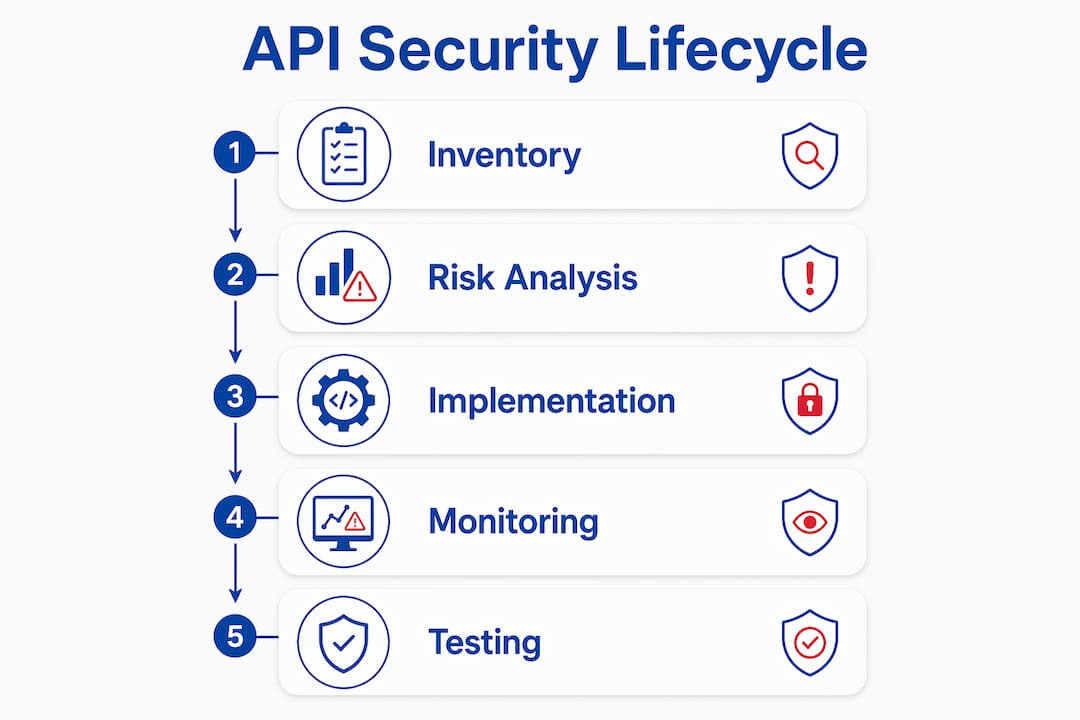
Ecommerce API inventory must cover not just endpoint lists but the sensitive business logic parameters that affect money and state. That includes price fields on cart APIs, inventory reservation counts on product endpoints, discount code parameters on promo APIs, and account balance fields on loyalty integrations. An attacker who can manipulate a price parameter during checkout does not need to breach your database.
Documenting these parameters requires more than a Swagger or OpenAPI spec export. You need to trace each parameter through its full lifecycle: where it originates, what validates it, and what downstream system consumes it. Tools like Postman collections and automated API discovery scanners help, but manual review of business logic flows remains necessary for promo and payment endpoints.
- Public storefront APIs: Product catalog, search, cart, checkout, and payment endpoints
- Authenticated customer APIs: Order history, account profile, address book, and loyalty points
- Internal admin APIs: Inventory management, pricing rules, discount configuration, and fulfillment triggers
- Third-party integration endpoints: Payment gateways like Stripe or Braintree, shipping providers, and fraud detection services
- Webhook receivers: Order status callbacks, payment confirmation hooks, and inventory sync endpoints
Pro Tip: Run an automated API discovery tool against your staging environment monthly. New endpoints added by developers or third-party plugins appear without security review. Catching them in staging costs far less than patching a live breach.
What implementation steps protect sensitive transactions and data?
Signed requests for tamper-proof API calls
Signed requests attach cryptographic digital signatures to API calls, verifying both the origin and the integrity of each request. This prevents man-in-the-middle attacks from modifying payment amounts or order details in transit. The server rejects any request where the signature does not match the payload, even if the attacker holds a valid authentication token.
Implementing signed requests on payment and order APIs means an attacker who intercepts a checkout call cannot change the price field without invalidating the signature. This control is especially critical for ecommerce platforms that pass order totals between microservices internally, where TLS alone does not prevent insider tampering.
Rate limiting tuned to ecommerce behavior
WooCommerce Store API rate limiting supports keying limits by user ID, IP address, or custom identifiers, and handles proxy headers for realistic client identification. By default, it applies limits to POST requests only. You must explicitly configure it to cover HTTP method overrides, or attackers can tunnel POST requests through GET to bypass limits.
Rate limiting effectiveness depends on matching real customer behavior. A legitimate customer rarely submits more than three checkout requests per minute. A bot testing stolen credit cards submits hundreds. Setting thresholds based on observed traffic patterns rather than arbitrary numbers reduces false positives without leaving the door open to abuse.
- Key rate limits by user ID for authenticated endpoints, not just IP address
- Apply stricter limits to login, password reset, and promo code redemption endpoints
- Configure limits to cover HTTP method overrides explicitly
- Log all rate limit events and alert on sudden spikes in 429 responses
- Test rate limit bypass paths in staging before each deployment
Gateway enforcement with JWT and mTLS
Envoy Gateway supports enforcing mutual TLS (mTLS) and JWT access control policies at ingress, applying consistent security rules across all ecommerce microservices. This prevents gaps where one service enforces authentication and another does not. In Kubernetes-based ecommerce stacks, namespace-level policy gaps are a common source of unauthorized internal API access.
JWT tokens carry claims that identify the user, their role, and the token’s expiry time. Validating these claims at the gateway layer means a compromised service cannot escalate privileges by calling an admin API directly. mTLS adds a second layer by requiring both client and server to present valid certificates, blocking any service that does not belong to your trusted cluster.
NIST SP 800-228A provides REST-specific threat analysis that complements general API guidelines, with particular focus on the stateless nature of REST and the HTTP resource model. Statelessness means every request must carry full authentication context. Gateways that validate JWT on every request enforce this correctly.
| Control | What it protects | Implementation complexity |
|---|---|---|
| Signed requests | Payment and order payload integrity | Medium: requires HMAC or RSA key management |
| Rate limiting by user ID | Login, checkout, and promo abuse | Low: configurable in most API gateways |
| JWT validation at gateway | Authenticated endpoint access control | Low: supported natively by Envoy, Kong, and AWS API Gateway |
| mTLS at ingress | Internal service-to-service trust | High: requires certificate authority and rotation policy |
| BOLA object ownership checks | Order and account data isolation | Medium: requires server-side ownership validation per endpoint |
How to test and monitor ecommerce API security continuously
Continuous testing is the only way to maintain protection as your platform evolves. New features, third-party plugin updates, and infrastructure changes introduce new attack surfaces faster than manual reviews can track.
Integrate automated API security testing into your CI/CD pipeline. Automated testing covers both OWASP Top 10 risks and business-logic abuse patterns. Run tests on every pull request that touches an API endpoint, not just on scheduled scans.
Test both unauthenticated and authenticated endpoints separately. Public product and search APIs face different threats than authenticated order and account APIs. Unauthenticated tests check for information disclosure and enumeration. Authenticated tests check for BOLA, privilege escalation, and promo abuse.
Include business-logic attack scenarios in your test suite. Standard security scanners miss ecommerce-specific abuse like promo code stacking, negative quantity cart manipulation, and inventory reservation flooding. Write custom test cases for each of these patterns based on your platform’s specific flows.
Set up runtime monitoring with alerts on anomalous patterns. Track metrics like requests per endpoint per user, error rate spikes, and unusual geographic access patterns. A sudden spike in 401 responses on your login endpoint signals a credential stuffing attack in progress.
Define incident response triggers before an attack happens. Decide in advance what threshold of failed authentication attempts triggers an automatic block. Decide who gets paged when a payment endpoint returns unexpected 500 errors at scale. Pre-defined triggers reduce response time from hours to minutes.
Audit proxy behavior in rate limiting regularly. Rate limiting accuracy depends on correctly identifying the real client IP behind load balancers and CDNs. Misconfigured proxy header trust causes all traffic to appear as one IP, making rate limits useless or overly aggressive.
Key takeaways
Effective API security for ecommerce platforms requires layered controls spanning inventory, authentication, signed requests, rate limiting, and continuous testing aligned to NIST SP 800-228 and OWASP API Security Top 10.
| Point | Details |
|---|---|
| Start with a complete API inventory | Document all endpoints including internal admin and third-party routes with sensitive parameters. |
| Align controls to OWASP Top 10 risks | Map each risk category to specific ecommerce endpoints and assign mitigation ownership. |
| Use signed requests on payment flows | Cryptographic signatures prevent payload tampering even when authentication tokens are valid. |
| Enforce security at the gateway layer | JWT validation and mTLS at Envoy or equivalent gateways close gaps across microservices. |
| Test continuously in CI/CD | Automated testing covering business-logic abuse catches new vulnerabilities before they reach production. |
The security gap most ecommerce teams overlook
The most common mistake I see in ecommerce API security deployments is treating the network perimeter as the primary defense. Teams invest heavily in WAFs and DDoS protection, then ship checkout APIs with no server-side ownership validation on order objects. An attacker does not need to bypass your firewall if they can call /api/orders/12345 with their own valid token and read someone else’s order.
The second mistake is rate limiting configured against IP address only. Most credential stuffing attacks today rotate through residential proxy networks. Keying limits by user ID catches the attack pattern regardless of how many IPs the attacker uses. I have seen platforms where this single configuration change reduced fraudulent login attempts by orders of magnitude.
The third mistake is inconsistent policy enforcement across services. A gateway that enforces JWT on external traffic but allows internal services to call each other without authentication creates a path for lateral movement after any single service compromise. Security policy consistency across every layer of your stack is not optional in a microservices architecture.
My honest recommendation: start with the NIST lifecycle approach and implement controls incrementally. Pre-runtime controls like API inventory and threat modeling cost almost nothing compared to post-breach remediation. Runtime controls like rate limiting and signed requests can be added service by service without a full platform rewrite. The teams that get this right treat API security as an ongoing engineering practice, not a compliance checkbox.
— Canberra
Trickyhive can help you secure your ecommerce APIs
Securing ecommerce APIs across inventory, authentication, gateway enforcement, and continuous testing requires expertise that most internal teams build slowly through trial and error.
Trickyhive works with ecommerce platform operators and developers to implement the exact controls covered in this guide, from API discovery and OWASP risk mapping to gateway configuration and CI/CD-integrated security testing. The team brings hands-on experience with WooCommerce, Kubernetes-based stacks, and payment API security. If you want continuous detection, real-time analysis, and automated mitigation without rebuilding your security program from scratch, explore Trickyhive’s services and see what a managed approach looks like for your platform.
FAQ
What is API security for ecommerce platforms?
API security for ecommerce platforms is the set of controls that protect payment, checkout, order, and account endpoints from unauthorized access, data tampering, and abuse. It covers authentication, authorization, rate limiting, and continuous monitoring across all API layers.
What is the OWASP API Security Top 10?
The OWASP API Security Top 10 is a developer-focused list of the most critical API risks, including Broken Object Level Authorization and Broken Authentication. The 2023 edition includes ecommerce-specific attack scenarios and mitigation guidance.
How does rate limiting protect ecommerce APIs?
Rate limiting restricts how many requests a client can make in a given time window, blocking credential stuffing and cart abuse attacks. Keying limits by user ID rather than IP address alone is more effective against attackers using proxy networks.
What are signed requests and why do ecommerce APIs need them?
Signed requests attach a cryptographic signature to each API call, verifying that the payload has not been modified in transit. Ecommerce payment and order APIs need them because a valid authentication token alone does not prevent an attacker from tampering with price or quantity fields.
How often should ecommerce APIs be security tested?
Ecommerce APIs should be tested on every deployment through automated CI/CD-integrated security testing, not just on a quarterly schedule. Continuous testing catches configuration changes and new endpoints before they reach production.

A PHP and Laravel expert, he also excels in WordPress and front-end tech. As Co-founder of Base Software Ltd. and Founder of Priyo Career, he blends entrepreneurship with career guidance. Projuktibidda showcases his tech idea and knowledge.