



A SQL injection attack is a technique where attackers insert malicious SQL commands into application inputs to manipulate or access a backend database directly. Known in the security industry as SQLi, it ranks among the most exploited web application vulnerabilities tracked by OWASP. A successful attack can expose passwords, financial records, and private user data in seconds. For IT professionals and business owners, understanding SQL injection is not optional. It is the foundation of any serious database defense strategy.
How does a SQL injection attack work?
SQL injection works because web applications often build database queries by concatenating user input directly into SQL strings. The database engine cannot tell the difference between legitimate SQL and injected commands. It executes both.
Here is a concrete example. A login form might build a query like this:
SELECT * FROM users WHERE username = 'input' AND password = 'input';
An attacker types ' OR '1'='1 into the username field. The query becomes:
SELECT * FROM users WHERE username = '' OR '1'='1' AND password = '';
The condition 1=1 is always true. The database returns all user records, and the attacker bypasses authentication entirely.

The root cause of SQLi is failure to separate user input from executable SQL commands. String interpolation and concatenation are the most common coding mistakes that create this gap.
Attackers typically follow a three-step process:
- Probe the input. They submit a single quote (
') to trigger a syntax error. If the application returns a verbose database error, the attacker now knows the database type and possibly the table structure. - Map the database. Using error messages or behavioral clues, they identify table names, column counts, and data types.
- Extract or modify data. They craft payloads using UNION statements, boolean conditions, or time delays to pull or alter records.
SQL injection communication happens through three channels: in-band (attacker sends and receives data through the same channel), blind (attacker infers data from server behavior), and out-of-band (attacker uses a secondary channel like DNS or HTTP callbacks).
Pro Tip: Disable verbose database error messages in production environments immediately. Even a minimal error response can confirm a vulnerability exists and reveal the database engine type to an attacker.
What are the main types of SQL injection attacks?
SQL injection attacks fall into three categories based on how attackers retrieve information. Each type requires a different defense awareness.
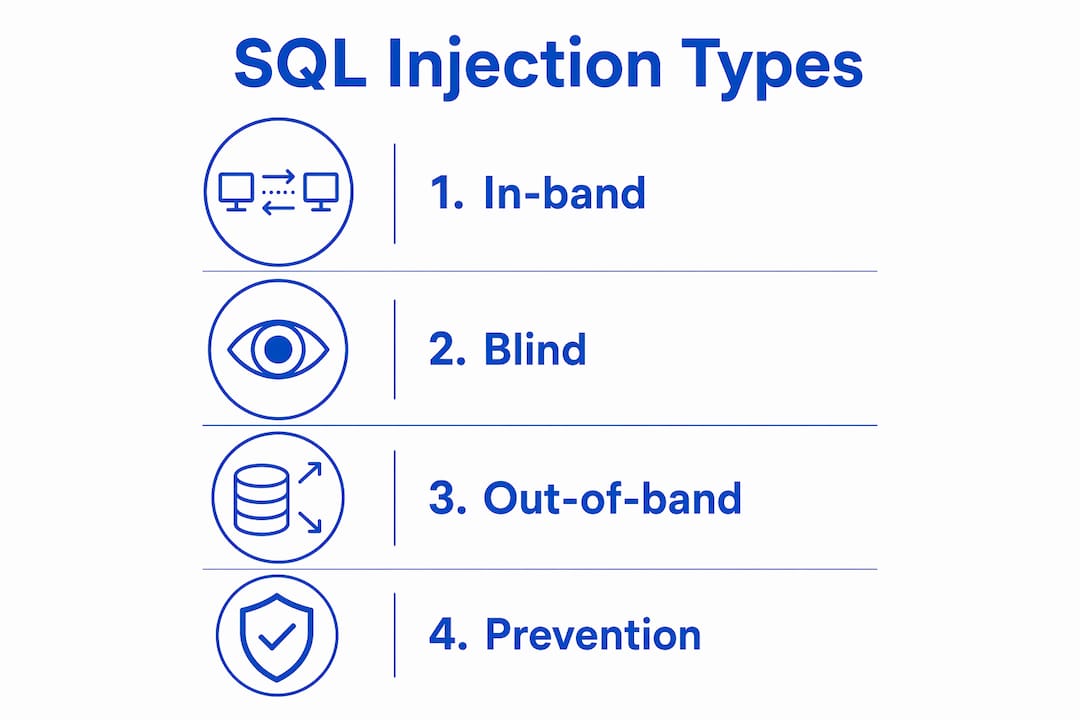
In-band SQLi
In-band SQL injection is the most common type. The attacker uses the same communication channel to inject the payload and receive results. Two subtypes exist. Error-based SQLi forces the database to generate error messages that leak schema details. Union-based SQLi appends a UNION SELECT statement to the original query to pull data from other tables.
Blind SQLi
Blind SQL injection returns no direct data output. The attacker infers information by observing how the application behaves. Boolean-based blind SQLi sends true/false conditions and reads page differences. Time-based blind SQLi uses commands like WAITFOR DELAY in SQL Server to cause deliberate pauses. A five-second delay confirms a true condition. Attackers use automation to reconstruct entire datasets this way, one bit at a time.
Out-of-band SQLi
Out-of-band SQLi uses a secondary channel, typically DNS or HTTP requests, to exfiltrate data. This method is less common but harder to detect because the malicious traffic does not travel through the application’s normal response path.
| Attack type | Method | Detection difficulty | Typical impact |
|---|---|---|---|
| In-band (error-based) | Triggers DB errors for schema info | Low | Schema exposure, data leakage |
| In-band (union-based) | UNION SELECT to pull extra data | Low to medium | Full data extraction |
| Blind (boolean-based) | True/false page behavior | Medium | Slow data reconstruction |
| Blind (time-based) | Timing delays via WAITFOR DELAY | Medium to high | Covert data extraction |
| Out-of-band | DNS/HTTP callbacks | High | Stealthy data exfiltration |
Pro Tip: Oracle databases carry an often-overlooked risk. NLS session parameters like NLS_DATE_FORMAT can be manipulated to inject SQL through data conversion, even when basic string handling looks secure.
What are the consequences and risks of SQL injection attacks?
A successful SQL injection attack causes damage across multiple dimensions. The technical breach is only the beginning.
- Unauthorized data access. Attackers can read any table the database account can access, including password hashes, credit card numbers, and personal records.
- Authentication bypass. The
OR 1=1technique lets attackers log in as any user, including administrators, without knowing a password. - Data modification or deletion. Attackers can run INSERT, UPDATE, or DELETE commands. A single injected DROP TABLE statement can destroy years of records.
- Reputation damage. Public disclosure of a breach erodes customer trust. Recovery costs include legal fees, regulatory fines, and lost business.
- Operational downtime. Cleaning up after a breach takes systems offline and consumes significant IT resources.
Verbose error messages in production environments are a direct enabler of these outcomes. They expose internal query structures, table names, and database types to anyone who probes an input field. Even an attacker with minimal SQL knowledge can trigger and exploit these errors by typing a single quote.
“Security is precision, not scale. Basic vulnerabilities cause most breaches. Scale does not protect you.” — Wiz Academy
The most damaging breaches in history trace back to SQL injection. High-profile incidents at major retailers and financial institutions have exposed hundreds of millions of records. The common thread is always the same: an unparameterized input field that no one thought to fix.
How can organizations prevent SQL injection attacks?
Prevention is not complex. It requires discipline and consistency across every database interaction in your application.
- Use parameterized queries. Also called prepared statements, parameterized queries separate SQL code from user data at the driver level. The database never interprets user input as executable code. This is the single most effective defense.
- Apply input validation and allowlisting. Reject any input that does not match an expected format. A phone number field should accept only digits. A name field should reject SQL keywords and special characters.
- Apply the principle of least privilege. Database accounts should have only the minimum permissions needed for their function. A read-only reporting account cannot execute DROP TABLE even if an attacker injects it.
- Avoid dynamic SQL concatenation. Never build queries by joining strings with user input. This applies inside stored procedures too.
- Monitor query behavior in real time. Active monitoring detects anomalous query patterns even when code-level flaws exist. Tools like database activity monitors flag unusual SELECT volumes or unexpected schema queries.
- Suppress verbose error messages. Return generic error pages to users. Log the full error server-side for your team only.
One critical misconception: stored procedures are not inherently safe. Stored procedures that concatenate user inputs into dynamic SQL are just as vulnerable as inline queries. Binding variables inside the procedure is what creates the protection, not the procedure wrapper itself.
Pro Tip: Run automated SQL injection scans with tools like SQLMap or Burp Suite against your own applications before attackers do. Finding your own vulnerabilities first is far cheaper than responding to a breach.
Key Takeaways
SQL injection remains one of the most preventable yet most exploited vulnerabilities because developers consistently fail to separate user input from executable SQL code.
| Point | Details |
|---|---|
| Parameterized queries are the top defense | Prepared statements prevent user input from being treated as executable SQL at the driver level. |
| Verbose errors accelerate attacks | Disable detailed database error messages in production to deny attackers schema information. |
| Stored procedures are not automatically safe | Procedures that concatenate user input into dynamic SQL carry the same injection risk as inline queries. |
| Least privilege limits breach damage | Restrict database account permissions so injected commands cannot access or destroy unrelated data. |
| Real-time monitoring adds a critical layer | Anomaly detection catches injection attempts even when code-level vulnerabilities have not yet been patched. |
Why I think most teams underestimate SQL injection until it’s too late
Most organizations treat SQL injection as a solved problem. They added a web application firewall, they ran one penetration test two years ago, and they assume the box is checked. That assumption is wrong.
The attacks that cause the most damage are not sophisticated. Simple probes like a single quote in a search field expose vulnerabilities that have existed in codebases for years. The attacker does not need advanced skills. They need one unparameterized input and a verbose error message.
What I have seen consistently is that teams focus security effort on the front door while leaving side entrances open. A login page gets hardened. A legacy reporting API that nobody maintains does not. That API connects to the same database.
The Oracle NLS session parameter vector is a perfect example of this blind spot. Most developers have never heard of it. It does not show up in basic security training. Yet it can bypass defenses that look correct on the surface. Precision matters more than coverage.
The fix is not expensive. Consistent parameterization of every database call, combined with suppressed error messages and least privilege accounts, stops the overwhelming majority of SQL injection attempts. The teams that get breached are not the ones who lacked budget. They are the ones who assumed their architecture was too complex to be targeted by something so simple.
— Canberra
Strengthen your cybersecurity posture with Trickyhive
SQL injection is one piece of a larger security picture. Knowing the threat is the first step. Acting on it consistently is what keeps your data safe.

Trickyhive covers cybersecurity, web development, and AI topics built for IT professionals and business owners who need practical, no-nonsense guidance. Whether you are auditing your application code, evaluating security tools, or training your development team, Trickyhive’s cybersecurity resources give you the depth and clarity to make informed decisions. Explore the full library to stay ahead of evolving threats and build defenses that hold up under real-world pressure.
FAQ
What is SQL injection in simple terms?
SQL injection is an attack where a malicious actor inserts unauthorized SQL commands into an application’s input fields to manipulate the connected database. The database executes the injected commands as if they were legitimate instructions.
How does SQL injection bypass login authentication?
Attackers input conditions like ' OR '1'='1 into login fields. This makes the SQL query return true for every record, granting access without a valid password.
Are stored procedures safe from SQL injection?
Stored procedures are not safe if they build queries by concatenating user input into dynamic SQL. Binding variables inside the procedure is what prevents injection, not the procedure itself.
What is the most effective SQL injection prevention technique?
Parameterized queries, also called prepared statements, are the most effective defense. They separate user input from SQL code at the database driver level, making injection structurally impossible.
How do attackers use blind SQL injection?
Blind SQL injection attackers observe server behavior rather than reading direct output. They use timing delays or true/false page responses to reconstruct database contents one piece at a time through automated guessing.

A PHP and Laravel expert, he also excels in WordPress and front-end tech. As Co-founder of Base Software Ltd. and Founder of Priyo Career, he blends entrepreneurship with career guidance. Projuktibidda showcases his tech idea and knowledge.